Trip of a Lifetime by Liz Byrski

May 13, 2008

First of all a declaration - I know Liz personally having worked with her. Since that time she’s gone on to write 4 novels and one memoir and probably countless non-fiction works.

Trip of a Lifetime is Liz’s latest novel and is set in Newcastle in New South Wales (where according to the acknowledgements, her son lives). Heather Delaney is the local member and one night after work she is shot in the shoulder. This sets up the tension in the story which compares and contrasts the lives of several “older” women.

There’s Heather - successful, single mid 50s politician. Jill, successful working mother of two tweens, mid 50s. Diane, bitter divorcee, also in her 50s with a grown up daughter on drugs and Barbara, in her 70s, single, successful now retired, with a “male friend of significance” shall we say.

All of Liz’s books feature women of a certain age and that certain age is the one that no one else is writing about! Perhaps that is why her books have found their niche. These women are still having sex (well… most of them), and still have many of the problems - insecurity, body-image, jealousy etc - that their younger peers have. We just don’t hear about them.

Once your hair turns grey remember - you turn invisible - or at least, that’s how it seems.

In the story Heather gets contacted by an old flame - an old flame who it must be said treated her rather shabbily in the past. Perhaps she is vulnerable after the shooting but she latches onto this new-old love and appears to be falling into the old relationship.

Now, I don’t know if you remember Liz’s story - she wrote about it in her memoir Remember Me but I wondered if she used her rekindled love story as the basis for this relationship between Heather and Ellis.

I’m not saying that her Karl is anything like Ellis - that would probably be slander - but I wonder if the emotional roller-coaster that Heather goes on are like the ones she must have felt when Liz reunited with Karl? The whole weird transposition of bodies… you remember the young person you were in love with - your body remembers their body - but the reality is the older version. Very different from growing older together I think.

And then (and I don’t know whether this is Liz’s personal experience or not) mentally you’re in a different place. You’ve added decades of experience to your decision making processes… emotional as well as practical… but you expect your old lover to respond in the same way they would have back then. A very interesting dilemma.

I wonder if any relationship could survive that?

Anyway I digress, back to the book.

It’s a fast, holiday read. A bit Maeve Binchy. Interesting but not challenging - but it’s not claiming to be Booker Prize fiction. :)

Extras by Scott Westerfeld

May 4, 2008

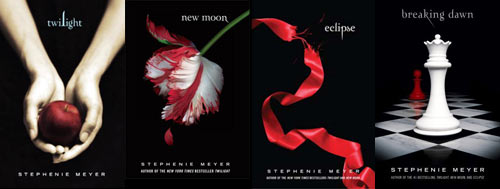
The four Uglies booksExtras is the fourth book in the Uglies trilogy. Well, strictly speaking the trilogy - Uglies, Pretties and Specials - stands alone. Lets just say this is another book set in the Uglies world. You can read my review of that series here.

Extras is set around a new heroine in another city - this time in Japan. This city is based on a “reputation economy” where the most famous get the most resources. Sound familiar? To get famous you either need to be clever at something or you need to report or “kick” the story.

Fame is everything.

Your fame buys you luxury apartments, beautiful clothes, invitations to the most exclusive of parties. It’s kind of how our celebrities live now!

(You can also get merits by being a doctor or scientist… the merit system runs alongside the reputation economy.)

If you want a glimpse into the future this could be it. Obviously Scott Westerfeld has spent some time in Asia. In his future world anyone can “kick” a story. From our 15 year old heroine’s point-of-view, it’s her chance to go from a “face rank” of 451,369 into the top 1000.

The kickers in his story are our “Naturals” of today. They don’t travel anywhere without their cameras, they are completely at home with hi-tech equipment and then they “kick” their stories onto the internet. Just like on social networking sites of today - but of course far more integrated into their society. :)

Stories are then “kicked” on by others - just like you Stumble and Digg stories today.

I think that’s why I’ve found this series so engaging. Scott manages to pick up on contemporary themes and spin them out to see where they go.

A good series for teens, late tweens and young minded adults. :)

Wideacre by Philippa Gregory

April 16, 2008

Wideacre by Philippa GregoryYou are probably more familiar with Philippa Gregory’s later historical novels from the Tudor period: The Other Boleyn Girl etc… I say later because they were written this century although the period they write about is in fact earlier in time than this series which was written earlier, in 1987. Confusing maybe?

Wideacre is set in the late 1700s. A younger daughter born to the Quality in Sussex aches to own the land she farms. Her father - the squire - is her idol and she can’t bear the thought that one day she must marry and leave the farming lands she knows and loves.

This is a bodice ripper to the highest order.

As the review on the cover says: “Beatrice Lacey leaves Scarlett O’Hara in the dust” or words to that effect…

There are no lengths to which she will not go to stay on Wideacre. And some of the lengths she goes to are long indeed. At some points I audibly groaned and had to put the book down.

She’s surrounded by a pretty wet bunch most of the book who let her get away with it it must be said.

It all gets a bit too much in the end and the ominous spectre of her past seems a little contrived - hey it’s a fictional bodice ripper - what should I expect - nonetheless I enjoyed the escapism and will probably pick up the next two in the trilogy for a gander.

A Concise Chinese-English Dictionary for Lovers by Xiaolu Guo

April 6, 2008

A Concise Chinese-English Dictionary for Lovers by Xiaolu GuoI picked up this book in my local bookshop last Sunday. It was a toss up between this one and a Philippa Gregory novel Wild…something…

I loved the way this book started. “Sorry of my English.”

Zhuang is a Chinese language student who arrives in London to attend an English language school in order to get ahead in China.

The book begins in broken English: “Is unbelievable, I arriving London, ‘Heathlow Airport’. Every single name very difficult remembering, because just not ‘London Airport’ simple way like we simple way call ‘Beijing Airport’. Everything very confuse way here…”

Broken but charming, her language is quite poetic: “Immigration officer holding my passport behind his accounter, my heart hanging on high sky.”

Xiaolu Guo’s insights are also really interesting and sometimes funny: “People say ‘I’m going to go to the cinema…’ Why there two go for one sentence? Why not enough to say one go to go?”

I felt inside her skin as she tried to make sense of the alien Western world and as she comments on the differences learning learning learning about her culture.

Now I suppose the title should have given it away… after all “for lovers” is a pretty big hint, but I was surprised at the amount of sex in this book. It’s not confronting, just… surprising. But it makes sense as part of the novel, for this innocent from China is not only discovering the Western World but also herself, her sexuality.

I really enjoyed this novel. It’s very cleverly written. Zhuang’s English gets better and better throughout the book. And as her language gets better, so does the depth of her insight.

My favourite expression is her description of the English sun while she’s in Portugal: “They got a real sun here in their sky, not like in England. English sun is a fake sun, a literature sun.”

Right on the money!

The Hanging Garden by Ian Rankin

March 31, 2008

Ian Rankin Hanging GardenIan Rankin’s book The Hanging Gardenis one of his Inspector Rebus novels. You might have seen the Rebus TV series starring John Hannah?

In this book Rebus investigates two crimes. A war crime and some gangster in-fighting. Both complex, both in their way intriguing and somehow inter-related.

Rebus is a miserable bugger. Wedded to his job. Broken marriage. Recovering alcoholic. He’s a loner but of course a loner with the insight to resolve these puzzling crimes, even prevent them.

It’s set in the grimy underworld of Edinburgh and the grey setting perfectly matches Rebus’s mood.

I haven’t read an Ian Rankin novel before. He intersperses his prose with song titles which is a bit off-putting at first. Is it part of the text or a suggested accompanying playlist? Maybe they are what Ian was listening to as he wrote.

Overall, I enjoyed the read. He sets a mean pace and I was carried along with the plot.

Worth picking up if you like crime fiction.

Other reviews:
Complete review
Amazon (scroll down to find it)

Chinese Cinderella by Adeline Yen Mah

March 30, 2008

Chinese CinderellaI picked up this book over Easter. One of our teenage guests had read it for school and was writing a paper on it. It’s not a long read - I read it over the course of a morning.

Chinese Cinderella is the autobiographical tale of Adeline Yen Mah - you may have seen her book Falling Leaves, a more adult memoir.

The story is of her childhood, growing up in China during the second World War. She is the fifth child of a fairly wealthy man and two weeks after her birth her mother dies - she is thought of as bad luck. Her father re-marries soon after and the new stepmother is - as you might expect from the title - not the most even-handed particularly when her own two children arrive on the scene.

She is not allowed to invite friends home, never celebrates birthdays, has no new clothes etc.

Her only champion is her aunt and to a lesser extent her grandfather, whose power wanes as the stepmother’s grows.

It is a sad tale but for some reason I lost sympathy with her. It just felt like a whinge. Now I’m sure her life was hard. Beyond imagining even, but somewhere along the line, she lost me. Perhaps it was because the story was told more simply for a younger audience.

I wonder if her adult autobiography would elicit the same response.

Have you read this book? What did you think?

Another review:
Reading Matters
It is an extraordinary catalogue of abuse and malice which will stay with you for quite a while after you finish the book. And I think you might find this book actually enjoyable, despite the content, because it is so well written.

Dear John by Nicholas Sparks

March 30, 2008

Dear JohnI picked this book up at the airport waiting for someone called John. On reading the first couple of pages I discovered it was set in Wilmington. We loved Wilmington on our recent trip to the US and so it seemed as if the universe was speaking and I should try out this new author. New to me anyway…

Dear John by Nicholas Sparks is the story of an Army infantry soldier who falls in love and then has to let his love go. No don’t worry I haven’t given away the ending - Sparks tells you that almost in the first sentence.

Yes, a love story. From a man’s point of view written by a bloke.

Interesting. I haven’t read too much male romantic fiction in my time.

There are a few macho bits. The action in Iraq for example, the odd fisticuffs on the beach, but mostly this is a story of a bloke and his feelings. A lot about his feelings - for his girlfriend, his dad, his girlfriend’s childhood friend…

I enjoyed it. It’s not challenging to read. A fairly gentle story with a hint of doom and you wonder all the way through why it all goes pear-shaped given the depths of his feelings.

Not a bad holiday read.

Other reviews:
Inthenews.co.uk
Book Reporter

The Cleft by Doris Lessing

March 29, 2008

The Cleft Doris LessingI started reading The Cleft intrigued by this idea of women existing in a population without men. Spontaneously becoming pregnant and birthing only girl babies. Then comes the fateful day when a “monster” is born - a boy baby. How they react to this change in their circumstances and how it changes their society is the story of The Cleft.

I haven’t read any Doris Lessing books before and was expecting something along the lines of Jean M. Auel. Personalised storyline, detail, descriptions of their daily life.

I was disappointed.

Lessing tells the story through an aging Roman senator who is an historian. You get a taste of how she can write about characters through his tale but then she goes from his story to this buried history of early man. He’s sifting through scraps of old documents collating the story.

This way Lessing can describe the development of the Clefts and the Squirts (I imagine you can guess which are men and which are women) over generations.

But it didn’t work for me. I found it distanced me from the story. I was more interested in the Senator. I resented the dry, almost historical sections about the Clefts when that should have been the focus. I didn’t particularly care about the various characters (not that there was any character development) in the early world and while I maintained an interest - I wasn’t engaged.

I think Lessing missed an opportunity here to bring the story to life. By treating it as a history she took it out of the world of fiction and into the world of non-fiction. It read like a history not a novel and I felt well… pissed off actually.

It might be your bag, it wasn’t mine.

She won a Nobel Prize for Literature. Meh.

Other reviews:
The Guardian
The Australian

The Broken Shore by Peter Temple

March 15, 2008

The Broken ShoreI first heard about Peter Temple on Matilda and then while I was frantically searching for something to read on the plane to Broome, my colleague mentioned him too. So I picked up The Broken Shore and started reading it on the plane.

The story is of a broken cop, “retired” in the town he grew up in, on a property gone to rack and ruin. He is called in to investigate the murder of a local businessman. There are racial tensions in the town, bent cops, it’s grimy, grim and sinister.

Peter Temple writes in a very spare way and after reading the flowery prose of Daphne Du Maurier that took a while to get used to. I found myself getting lost and referring back a bit. It felt like a story I wasn’t going to get into.

But I persevered and you know, I got into it. I was intrigued to find out why this cop was broken. I thought I’d guessed who’d done it and I wanted to be proved right. I wanted to see if he ever was going to restore his grandfather’s house. I guess I started investing in the character. I wanted him to be alright.

At times it felt a bit “Wire in the Blood” ish. Some really gross stuff happens.

Overall though, I liked it and would probably try another Peter Temple. I like that he is Australian too.

Other reviews:
The Age, Dagger Award, First Tuesday Bookclub Forum, Mostly Fiction, Matilda.

Rebecca by Daphne Du Maurier

March 11, 2008

rebecca

Rebecca is not the easiest of novels to get into. Opening with a dream scene with heavy descriptive prose in this day and age can be a bit of a chore, but once you get into maybe chapter 3, after all that depressing looking back at Manderley, it’s really worth the effort.

Du Maurier sets the scene. Here is a couple who once lived in a beautiful grand house in Cornwall - we assume it’s Cornwall - the house - Manderlay is no more. They live a tedious mundane life in hotels where she - the heroine is never named - is completely subsumed by her husband. Choosing what she reads with care lest she upsets him.

How did they get there? It is with this impending sense of doom that we then get into the novel proper. Du Maurier completely gets suspense. It is oppressive in this book - you know where the heroine is heading.

The heroine - only known as Mrs de Winter is the second wife of Maxim. His first wife, Rebecca, has died tragically at sea. Her maid/housekeeper/friend Mrs Danvers lives to keep her memory alive.

Rebecca is the polar opposite of the new Mrs de Winter. She is outrageous, flamboyant, extroverted and independent. Our heroine is timid, conventional, submissive, and mousy.

Apparently the two Mrs de Winters are like the two sides of Daphne Du Maurier in real life. Interesting.

As I said, once you get past the first couple of chapters it really is a good read and from the Fancy Dress Ball - unputdownable. So much for my early night last night.

What is intriguing to me is how powerful the Mrs Danvers character is - despite her relatively minor role she is the one I remember from reading this book twenty years ago. And how much I was prepared to forgive Maxim.

Maybe I am more like the new Mrs de Winter than I would like to think?

Next Page »